TR-069 ACS
The Dimark ACS is a TR-069 Amendment 5 device provisioning and management solution designed to centralize the management, control, monitoring, and delivery of wired and wireless broadband services.
-
Best of Class Functionality
Including TR-069, TR-098, TR-104, TR-106, TR-135, TR-140, TR-142, TR-157, TR-181, TR-196, TR-262 and others. -
Field Tested and Proven
Deployed since 2004 across a very diverse array of platforms and environments, the Dimark ACS is a field proven and widely deployed solution. -
Scalable Architecture
Built on an industry standard and open Application Server architecture, the ACS is scalable, allowing it to support a virtually unlimited number of CPE devices. -
Built with Industry Best Practices in Mind
The ACS is based on widely deployed application server and database technologies and practices, so the same load balancing, clustering and failure recovery techniques used to provide massive scalability, and improved reliability and availability for large-scale sites and enterprise applications are applicable to accommodate a large and growing customer base. -
Open Architecture Reduces Time to Market
The ACS can either be implemented as middleware to be interoperable with existing OSS, Help Desk and NOC systems through XML, SOAP or EJB3, or deployed as a standalone server that leverages the ACS’s GUI SDK to quickly create a customized web based interface. In either case, the ACS can be quickly up and running, minimizing time to market.
Please contact us for additional information or to arrange for a technical review and software evaluation.
Licensees and partners, please Sign In for access to downloads and access to your support portal.
ACS Platform Technical Details
- Foundation: EJB3
- OS: Linux (x86 and IA64), Solaris, Windows, MacOS
- Application Server: Wildfly. JBoss and Weblogic support available
- Database: Postgres EDB, Oracle or MySQL
- Northbound Interface: JBeans, XML, SOAP
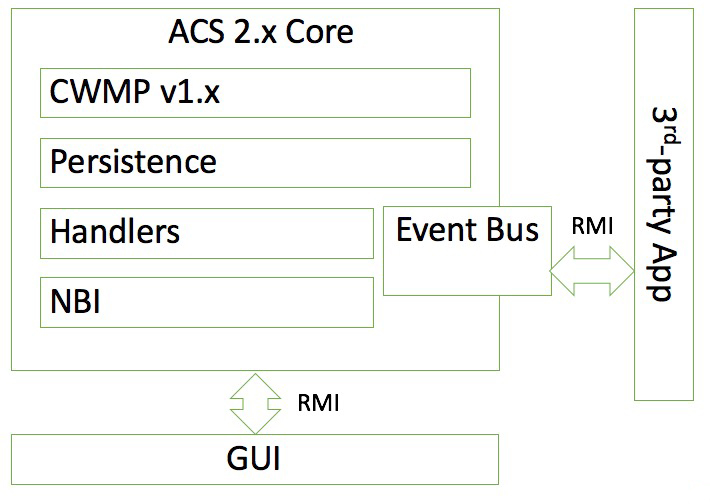
ACS Architecture